Poster Presentation Australasian Melanoma Conference 2026
Artificial intelligence Dermoscopy scoring system (DEXI) against histologically proven melanoma in situ : a primary care cohort study . (#430)
Title: Validation of an AI-Powered Dermoscopy Scoring System (DEXI) Against Histologically Confirmed Melanoma In Situ: A Primary Care Cohort Study
Background/Aim
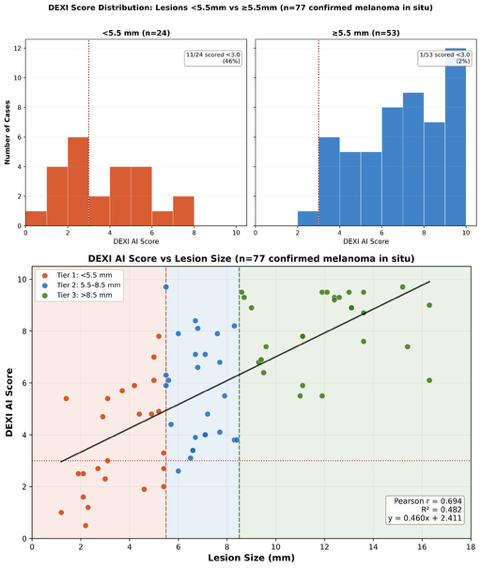
Artificial intelligence-assisted dermoscopy tools are increasingly proposed to support melanoma diagnosis, yet real-world validation against histologically confirmed outcomes in primary care settings remains limited. The Canfield IntelliStudio DEXI (Dermoscopy Explainable Intelligence) system generates an automated risk score and lesion size measurement designed to support clinical decision-making. This study evaluated the correlation between DEXI-derived risk scores and lesion size against histologically confirmed melanoma in situ, and explored diagnostic performance across a clinically meaningful size-based tiering framework.
Methods
We retrospectively analysed 77 consecutive, histologically confirmed melanoma in situ cases identified at a primary care skin cancer centre (SkinMasters Terrigal, NSW), each scored by the DEXI system at the time of clinical assessment. Correlation between DEXI risk score and lesion size (mm) was assessed using Pearson and Spearman coefficients. Cases were stratified into a three-tier size framework (Tier 1: <5.5mm; Tier 2: 5.5–8.5mm; Tier 3: >8.5mm) to evaluate score distribution and identify potential diagnostic blind spots.
Results
DEXI risk score correlated significantly with lesion size (Pearson r=0.694, Spearman ρ=0.701, R²=0.482; regression equation y=0.460x+2.411). Stratification revealed a diagnostically significant blind spot for lesions under 5.5mm: 92% of low-scoring cases (score <3.0) fell within Tier 1, despite histological confirmation of melanoma in situ.
Conclusion
DEXI risk scores show a moderate-to-strong correlation with lesion size in confirmed melanoma in situ, but small lesions are disproportionately under-scored by the system. This blind spot has direct implications for AI-augmented triage in primary care, where small early melanomas remain a critical diagnostic target. These findings support augmented — rather than autonomous — use of AI dermoscopy scoring in early melanoma detection pathways, where clinician expertise and synthesis of clinical metadata remain essential to safely embedding these tools in practice.