Oral Presentation Australasian Melanoma Conference 2026
Immune Cell Dynamics and Outcomes in Neoadjuvant-Treated Stage III Melanoma (#70)
Neoadjuvant immunotherapy-based regimens have improved event-free survival outcomes for patients with resectable macroscopic Stage III melanoma. Here we evaluated immune cell dynamics in the tumor microenvironment in association with 3-year recurrence-free (RFS) and distant metastasis-free (DMFS) survival to a novel regimen. We hypothesized T-cell receptor (TCR) fraction and clonality would be higher and immune activation signatures and pathways more highly expressed in patients without recurrence.
Methods
The Phase II NeoACTIVATE trial (NCT03554083) enrolled patients based on BRAF status to 12 weeks neoadjuvant atezolizumab with vemurafenib plus cobimetinib (Arm A, BRAF mutated) or with cobimetinib (Arm B, BRAF wildtype), followed by therapeutic lymph node dissection and 6 months of adjuvant atezolizumab. We report updated 3-year RFS and DMFS outcomes with correlative bulk RNA sequencing and T cell receptor (TCR) sequencing from the involved lymph node (pre- and post-treatment) and an adjacent uninvolved node removed at operation.
Results
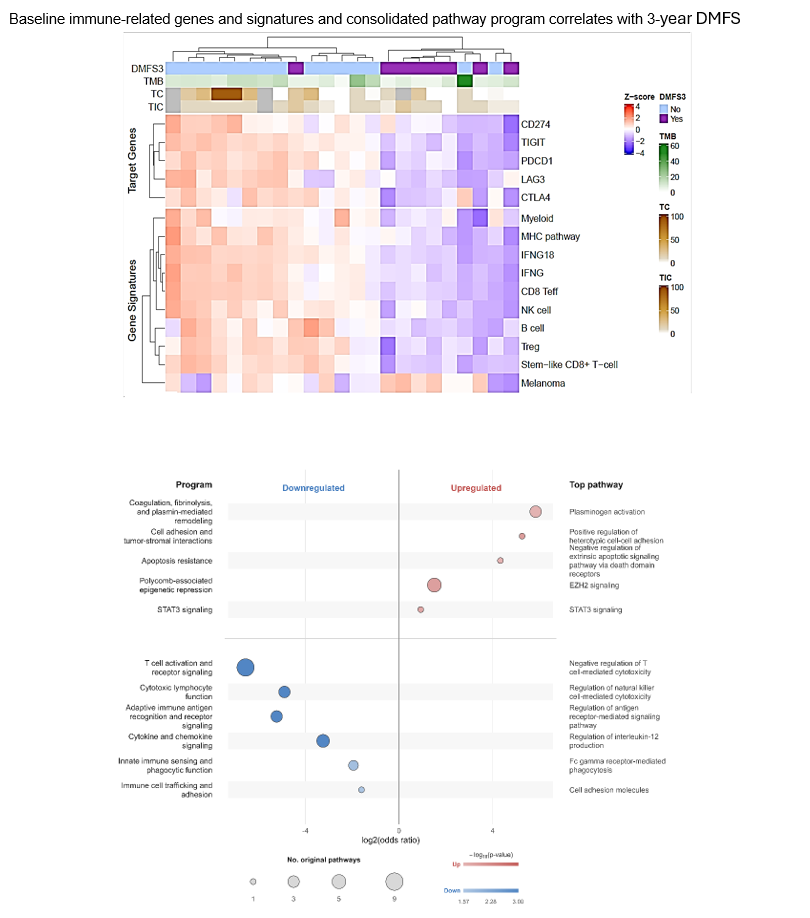
Of 30 patients enrolled, 27 patients were evaluable for analysis. At 36 months, 50% of Arm A and 61.5% of Arm B patients were recurrence-free. Major pathological response did not predict RFS. Bulk RNA sequencing revealed higher baseline expression of immune-related gene signatures in recurrence-free patients, while the melanoma-associated signature was enriched in those who recurred. Pathway analysis showed immune activation in patients without distant recurrence versus stromal remodeling and immune evasion programs in those who recurred. TCR sequencing demonstrated that a higher pretreatment T cell fraction was associated with improved RFS, while higher post-treatment TCR clonality in the index node relative to the adjacent uninvolved node was associated with both improved RFS and DMFS.
Conclusions
Neoadjuvant combined immunotherapy and targeted therapy can yield durable recurrence-free survival in patients with macroscopic Stage III melanoma. Pretreatment immune gene signatures and pathways, T cell fraction, and post-treatment TCR clonality outperform pathological response as predictive biomarkers in this setting. These data indicate that TCR repertoire characteristics within the involved and adjacent uninvolved lymph node may reflect differential immune responses to neoadjuvant therapy and could inform future studies evaluating biomarkers to stratify risk of recurrence and inform personalization of therapy.