Poster Presentation Australasian Melanoma Conference 2026
Q-Inform: A randomised control trial of risk-stratified screening advice for melanoma – study design and recruitment (#423)
Background/aim: Although early detection of melanoma has potential benefits, population‑wide skin screening is not recommended due to insufficient evidence of the balance of benefits and harms. Current RACGP guidelines recommend opportunistic skin examination only for individuals at above‑average risk for melanoma. It remains unclear whether providing personalised melanoma risk information motivates individuals to engage in recommended skin‑screening behaviours. This study aims to compare the impact of delivering a clinical risk score or a genetic risk score versus a control group on adherence to recommended skin examination advice, sun-safety behaviours, and melanoma‑related worry.
Methods: This open‑label randomised controlled trial, nested within the QSkin cohort, will compare three conditions: receiving a clinical risk score (CRS) for melanoma, versus receiving a genetic risk score (GRS) for melanoma, versus receiving general advice on sun-safety (control arm).
Eligible participants:- 51-75 years old (inclusive)
- No history of invasive or in situ melanoma
- Have a concordant clinical risk score versus genetic risk score.
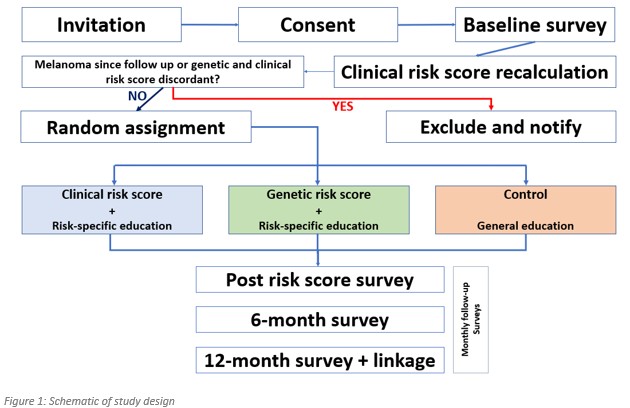
Recruitment: 9,870 QSkin participants are eligible for invitation, with an anticipated ~50% response rate. CRS will be recalculated at baseline using updated participant data as some factors influencing CRS may have changed. As prior QSkin data showing 30% non-adherence, 247 participants per arm are required to detect a 40% relative reduction in non-adherence with 80% power, allowing for a 20% dropout rate. Expected recruitment will provide adequate power to detect smaller effect sizes.
Conclusions: This study will provide evidence on whether personalised CRSs or GRSs can influence adherence with risk‑appropriate skin checks. Findings will inform the feasibility and risks of implementing risk‑stratified melanoma screening programs in Australia.