Oral Presentation Australasian Melanoma Conference 2026
Can less be more? Exploring consumer and clinician perspectives on deintensification in melanoma using digital democracy tools (#46)
Background
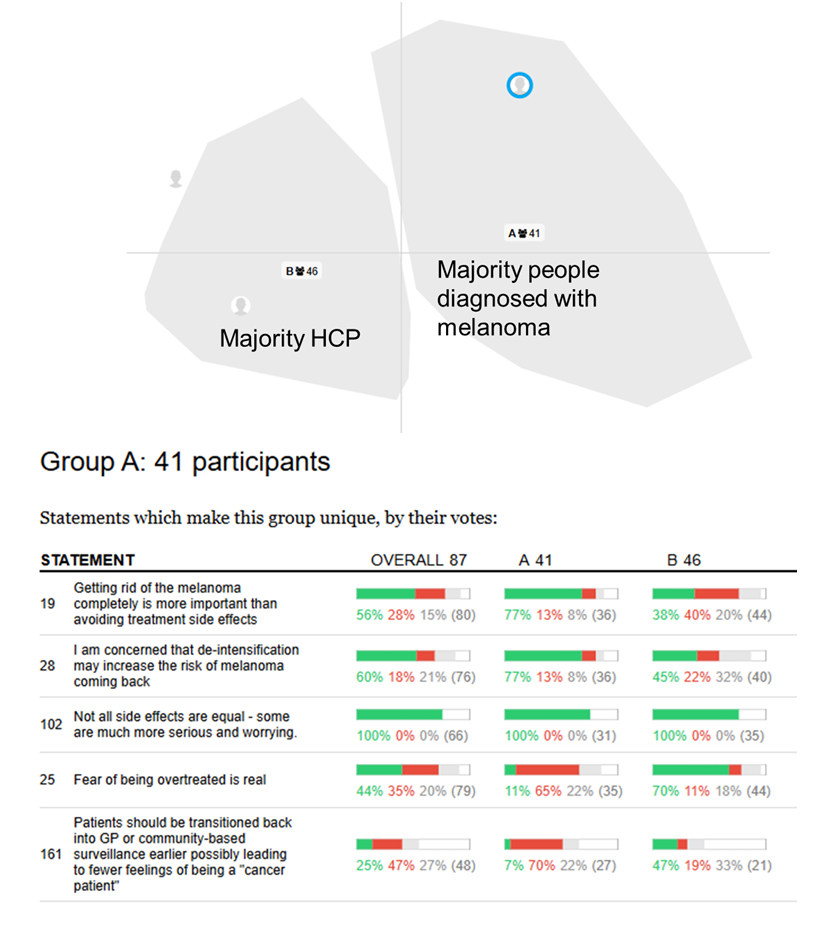
Deintensification – reducing cancer treatment without compromising outcomes – can optimise survival and quality-of-life, reduce overtreatment, and improve healthcare resource utilisation. However, clinician and consumer attitudes towards deintensification in melanoma remains largely unknown. This study aimed to initiate dialogue using Pol.is, a digital democracy tool, augmented with demographic data and topic modelling (TM) to explore conversation subtopics.
Methods
Australians with lived experience of melanoma (LEM), their carers, and clinicians were invited to participate in the two-week online conversation. Demographics were collected via a linked Qualtrics survey. Pol.is seed statements were co-designed with a Consumer Working Group to establish the Pol.is conversation tone. Participants voted agree/disagree/unsure to statements and could contribute their own. Real-time feedback of opinion groups was generated through principal component analysis and k-means clustering. TM and linked demographic analyses provided additional insights to grouping and topics.
Results
There were 98 participants: 47 LEM, 41 clinicians, and 10 carers, with strong regional/remote representation (28%, 5%). Two opinion groups emerged: Group A, majority LEM, and Group B, majority clinicians. Group A voted consistently on statements balancing toxicity risk and efficacy and were less concerned about overtreatment (11% vs 70% Group B). Group B emphasised the need for better guidelines and evidence and held a more utilitarian view towards resource usage within the healthcare system. There was strong consensus between Group A and B that patients should be informed of all treatment options (88% vs 100% agree), that risk of overtreatment is worse than undertreatment (72% vs 58% disagree), and that more research is needed in this space (87% vs 100% agree). TM revealed five topics: the impact of insurance coverage on treatment, regionality and healthcare access, biomarker-guided approaches, dose attenuation, and general support for deintensification. Whilst the study did not reach statistical power, it exceeded the threshold for a meaningful Pol.is conversation (n=50).
Conclusion
This study piloted a novel approach to consumer engagement in healthcare research that is easily scalable and may improve representation of diverse viewpoints. It highlighted areas of consensus and division between consumers and clinicians. Understanding these differences may facilitate effective implementation of deintensification strategies.