Poster Presentation Australasian Melanoma Conference 2026
The long and short of it: novel transcript discovery in melanoma using nanopore long-read RNA sequencing (#331)
Background: RNA splicing is dysregulated in cancer and can promote metastasis and therapeutic resistance. Aberrant splicing patterns have been identified in melanoma and significantly correlate with patient survival, highlighting clinical significance for melanoma patients. However, the melanoma transcriptome remains understudied and incomplete due to the limitations of conventional short-read sequencing that lacks full-length resolution of mRNA isoforms.
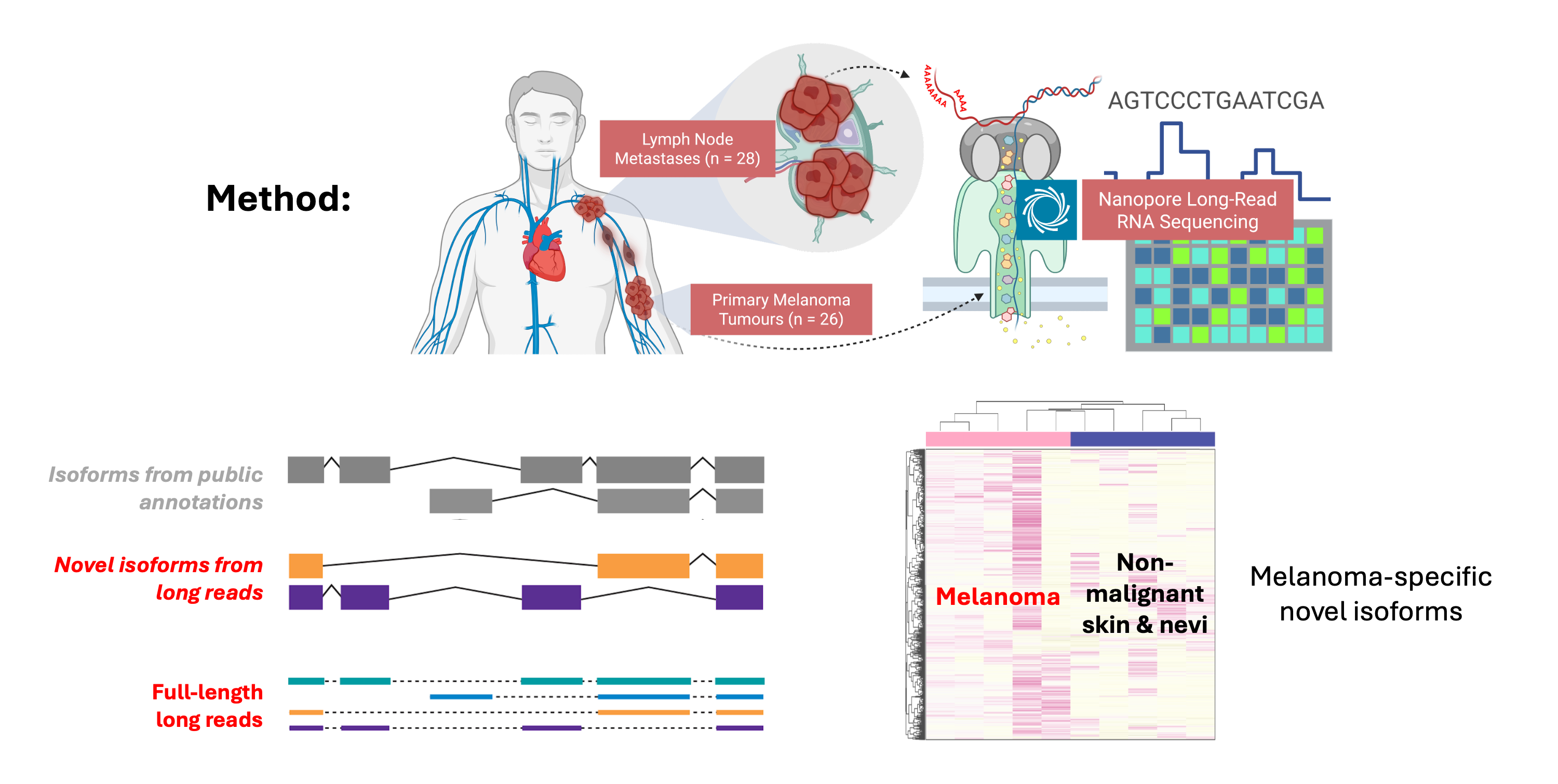
Method: We have deeply profiled 54 treatment-naïve melanoma samples collected from 47 patients with primary and/or lymph-node metastatic disease using Nanopore long-read RNA sequencing. A bioinformatic pipeline was applied to discover novel melanoma-specific isoforms that are absent from existing human transcriptome annotations. Novel isoform structure and expression were validated in multiple independent melanoma patient cohorts, and expression compared to normal tissues, using publicly available short-read data.
Results: Long-read RNA sequencing revealed a melanoma transcript repertoire of 86,752 distinct isoforms, including 7,929 high-confidence novel isoforms and 1,927 novel gene loci that were previously uncharacterized by the public transcriptome curation. Transcript expression analysis demonstrated that many novel isoforms were broadly expressed across melanoma patients but nearly undetectable in benign or non-malignant human tissues, highlighting the specificity of these novel isoforms to melanoma patients. Transcription factor (TF) motif analysis revealed that the promoters of novel gene loci contained DNA motifs enriched for TFs such as MITF, a major regulator of melanocyte development and melanoma progression, supporting the veracity of our discoveries. Moreover, regulatory TF and RNA binding protein motif analysis also identified important modulators of embryogenesis and the neural crest lineage, suggesting the potential reactivation of embryonic and lineage-specific splicing programs during melanoma development.
Conclusion: To our knowledge, this work is the first to leverage long-read RNA sequencing to transcriptionally profile a large cohort of melanoma patients. Current findings demonstrate that the splicing-driven transcript diversity is underappreciated in melanoma biology and may provide new actionable targets owing to their specificity to melanoma tumours. Experimental validation of novel genes and isoforms is ongoing to assess their underlying molecular functions and regulatory mechanisms to assess their potential as new biomarkers and targets for mRNA-based therapies in melanoma patients.