Poster Presentation Australasian Melanoma Conference 2026
Pathologic Response Following Neoadjuvant Therapy in Merkel Cell Carcinoma (#303)
Background/Aim: Merkel cell carcinoma (MCC) is an aggressive neuroendocrine tumor with a high propensity for recurrence and metastasis. For patients with unresectable disease, immune checkpoint inhibitors are front-line therapy, and chemotherapy can achieve significant responses. However, evidence to support the use of these agents in the neoadjuvant setting for patients with advanced but resectable disease remains scarce. This study aims to evaluate the responses to neoadjuvant immunotherapy and chemotherapy.
Methods: We conducted a retrospective analysis of patients with MCC who received neoadjuvant systemic therapy at a single institution from 2012 to 2026. Clinicopathologic variables, treatment characteristics, and response data were collected. Tumor viability was assessed on surgical specimens when available or estimated using clinical/radiographic findings. Pathologic response was defined as: complete (0% viable tumor, pCR), near-pCR (1-10%), partial pathologic response (pPR, >10–50%), and pathologic non-response (pNR, >50%). Our primary outcome was tumor response measured by percent viable tumor. Secondary outcomes, including overall survival, disease-free survival, and recurrence patterns, are pending.
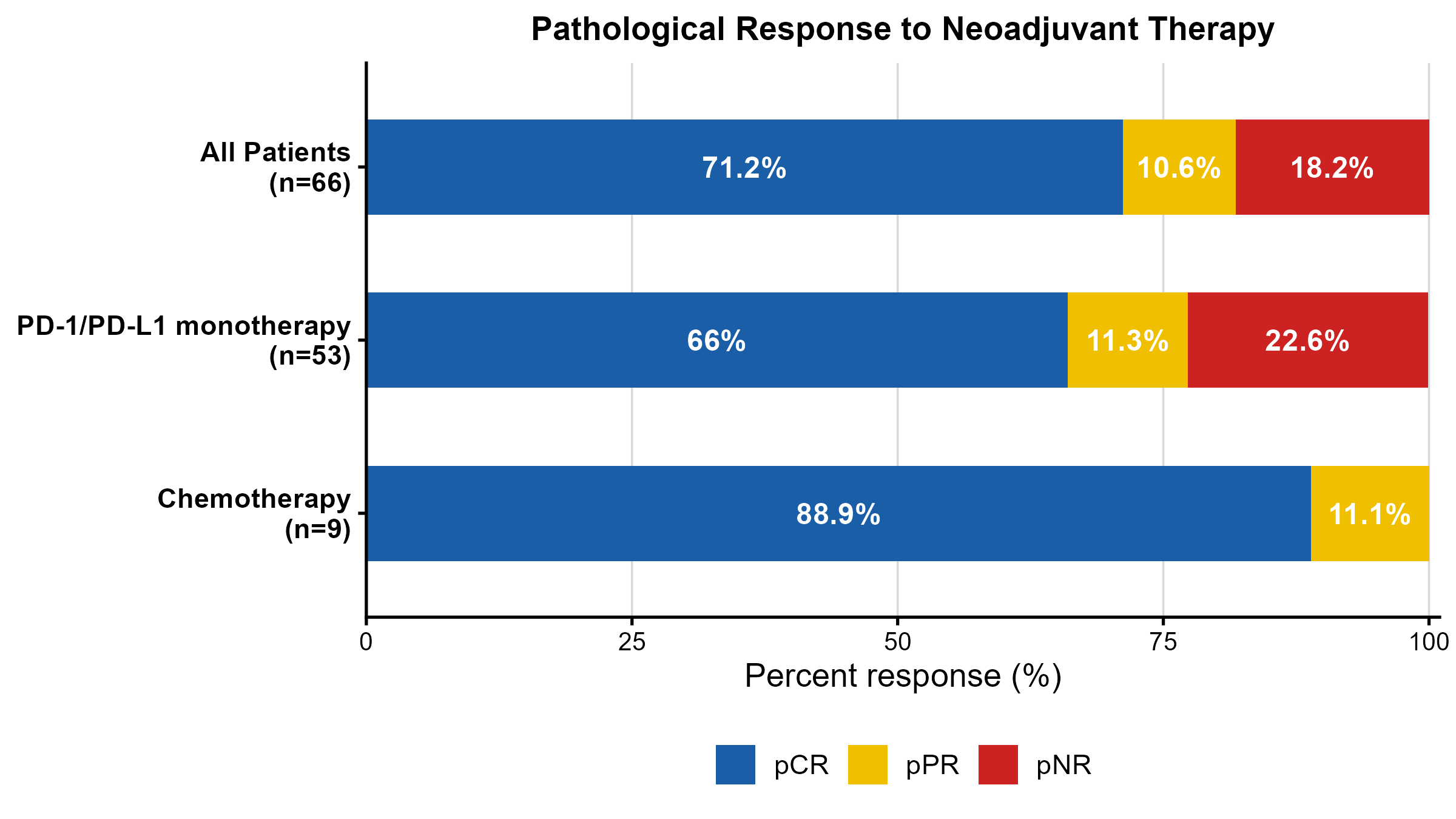
Results: A total of 127 patients were identified. Most (85%) presented with stage III disease, 11.8% with stage II, and 3.1% with stage IV disease. Single agent PD-1/PDL-1 inhibitors were used in 84 (66.1%) patients (avelumab 41.7%, pembrolizumab 17.3%, nivolumab 7.1%), chemotherapy was used in 34 (26.8%) patients (carboplatin/etoposide 13.4%, cisplatin/etoposide 13.4%), while 9 (7.1%) received other/multiple agents. 103 (81.1%) patients underwent surgery, of which pathologic evaluation, including percent viable tumor, was available for 66 (52.0%). Among them, a pCR was achieved in 71.2%, pPR in 10.6% and pNR in 18.2% of patients. Among patients who received single-agent PD-1/PDL-1 inhibitors (n=53), versus chemotherapy (n=9), pCR rates were 66% versus 88.9%, respectively. Of the 24 patients who did not undergo surgery, 2 had progression, 13 had clinical complete or near-complete response and 9 had an unknown status.
Conclusions: Neoadjuvant therapy in advanced MCC resulted in a pCR in approximately two-thirds of evaluable patients. With practice changing data on neoadjuvant immunotherapy in melanoma, our findings have encouraging implications for treatment of MCC. We intend to better characterize the pathologic response and outcomes of our entire cohort.
Figure 1.