Poster Presentation Australasian Melanoma Conference 2026
Spatial transcriptomic analysis of primary melanomas with extreme clinical outcomes. (#302)
Background
Most patients who die from melanoma do so after recurrence of early-stage disease. There is, therefore, an urgent need to improve the identification and management of patients with early-stage melanoma at high risk of recurrence. The tumour microenvironment (TME), subclonal tumour cell intrinsic features and cellular interactions likely play key roles in melanoma recurrence. Spatial transcriptomics (ST) is optimally positioned to characterise these factors and may provide novel insights and strategies to overcome early-stage melanoma recurrence.
Methods
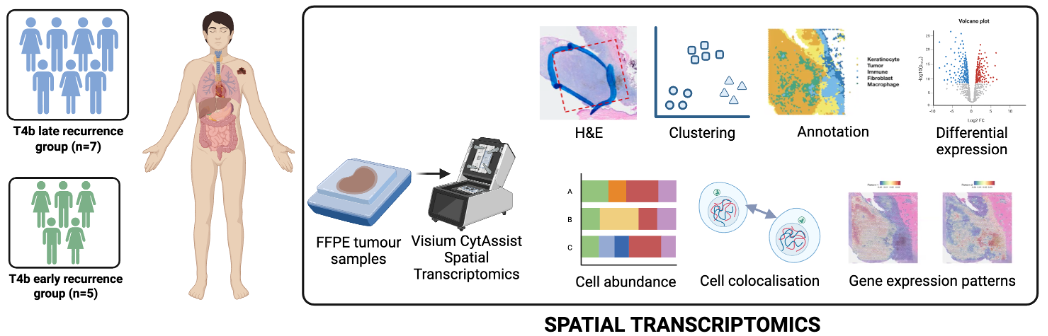
We examined 12 early-stage (thick, T4b) FFPE primary melanoma samples were identified from Melanoma Research Victoria: 7 with no recurrence ≤5 years of diagnosis and 5 had recurrence ≤5 years of diagnosis (late and early recurrence groups, respectively). Samples underwent 10X CytAssist Visium with comparisons between the two groups. Comprehensive bioinformatics analyses were performed: Bayespace/Harmony for spot clustering; SingleR for cluster annotation; RCTD deconvolution to refine cluster identification; edgeR and gene set testing of differentially expressed genes (DEG); sscomp for differential cellular composition; SPIAT for spatial immune–tumor architecture analysis; non-negative matrix factorisation (NMF) for exploration of gene expression patterns and interacting regions.
Results
Key cell types were revealed within each sample, including tumour cells, diverse immune cell subsets, fibroblasts, macrophages and keratinocytes. Tissue architecture including dermis, epidermis and invasive tumour front were well characterised. DEG identified downregulation of SLC5A10, GABRB3, SMIM38 and CDH7 in the late group relative to the early group. Gene set analysis revealed upregulation of the hallmark hypoxia, angiogenesis, EMT, glycolysis, IL2, TNFa and TGFb pathways in the late relative to the early group. Cellular compositions revealed the late group had significantly lower tumour purity and higher abundance of immune cells than the early group. NMF demonstrated significant downregulation of IGHA2, RBMXL3 and AIRE at the interacting region between tumour and immune cells in the late relative to the early group.
Conclusion
This study is one of the first to analyse primary melanoma samples with extreme clinical outcomes using ST. Differences in cellular composition of primary melanomas as well as differential expression of key genes involved in immune activation, inflammation and metabolism may be associated with melanoma recurrence.